Almost everyone wants to read more. We buy the books, add them to our shelves, and promise ourselves we will get to them. Then months pass, the pile grows, and the guilt grows with it.
The problem is a lack of desire to read. The reason is busy work, stress, and the endless pull of the phone. There is simply “no time” for books.
But the people who read dozens of books a year are not superhuman, and most are not speed-readers either. They have simply built smart habits that fit reading into normal, busy lives. Here is how you can do the same.
“You do not need more time to read. You need better reading habits.”
Let us look at practical ways to finish more books without magic tricks.
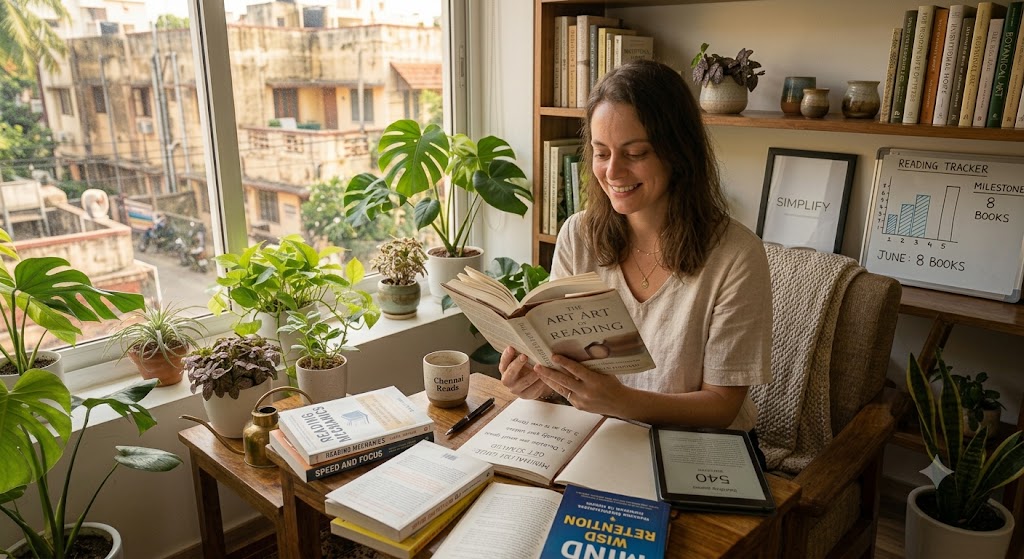
1. Always Carry a Book
The biggest reason people do not read is not lack of time, it is lack of a book in hand when time appears. Waiting rooms, queues, commutes, and idle moments add up to hours every week.
Keep a book with you always, physical or on your phone. When those small waiting shows up, you read instead of scrolling. Those minutes turn into finished books.
“The best book is the one you have with you when time appears.”
How to always be ready:
- Carry it everywhere — a book in your bag or an app on your phone.
- Fill dead time — read in queues, waits, and commutes.
- Replace scrolling — reach for the book instead of the feed.
2. Read a Little, Every Day
You do not need long, uninterrupted hours to read a lot. Consistency beats intensity. A few pages every single day add up to far more than an occasional long session that rarely happens.
Just twenty pages a day, which takes most people around twenty minutes, can mean over twenty books a year. Small and steady quietly beats big and rare, every time.
“Twenty pages a day is a bookshelf by year’s end.”
How to build the daily habit:
- Set a small goal — a fixed number of pages or minutes daily.
- Pick a fixed time — before bed or with morning coffee.
- Never zero — even one page keeps the streak alive.
3. Quit Books You Don’t Enjoy
Many people read slowly because they are stuck in a book they secretly dislike. They feel they must finish it, so they read nothing at all rather than move on. Guilt kills the habit.
Permit yourself to quit. If a book is not working for you, put it down and pick another. Life is too short, and there are too many great books, to slog through a bad one.
“Finishing a boring book is not discipline. It is a waste of reading time.”
When and how to quit:
- Give it a fair try — a few chapters before deciding.
- Drop it freely — no guilt about not finishing.
- Move on fast — a book you love beats one you endure.
4. Choose the Right Format
You do not have to read every book with your eyes. Audiobooks and e-books open up time and places where a physical book cannot go. The format should fit your life, not the other way around.
Listen to audiobooks while you’re travelling or walking. Use e-books for reading in bed or on the go. Mixing formats lets you read in far more moments of your day.
“The best format is the one that fits the moment you have.”
How to use formats smartly:
- Audiobooks — for commutes, walks, and chores.
- E-books — for travel and reading in low light.
- Physical books — for focus and fewer distractions.
5. Cut the Real Time Thief
Let us be honest about where the time actually goes. For most people, the reading hours are “lost” due to time spent scrolling social media and watching endless clips. That is where your reading time hides.
You do not need to quit screens entirely. Just swap a small part of that time for reading. Giving 30 minutes of scrolling to a book transforms how much you read.
“You have time to read. It is currently being spent on your phone.”
How to reclaim the time:
- Track your screen time — see how much you actually scroll.
- Swap a little — trade some scrolling for reading.
- Remove temptation — keep the phone away during reading.
6. Set a Simple Reading Goal
A clear goal turns a vague wish into real action. “I want to read more” achieves little. “I will read one book a month” gives you something concrete to aim at and track.
Set a target that feels doable, then track your progress. Watching the number of finished books grow is surprisingly motivating and keeps the habit alive through busy stretches.
“A wish to read more does nothing. A clear goal to read gets it done.”
How to set the goal:
- Pick a number — like one book a month or twenty-five a year.
- Track it — keep a simple list of finished books.
- Adjust as needed — raise or lower it to stay realistic.
The Takeaway
Reading more is not about reading faster or having endless free time. It is about weaving reading into the life you already have, one small habit at a time, until finishing books becomes normal.
Here is the whole plan at a glance:
- Always carry a book — read in life’s small gaps
- Read daily — a few pages beat rare long sessions
- Quit bad books — free yourself to read good ones
- Use all formats — audiobooks and e-books add reading time
- Cut the phone time — swap scrolling for reading
- Set a goal — a clear target keeps you going
“The reader who finishes many books is simply the one who never stopped reading a little.”
Pick one habit and start today, maybe reading twenty pages tonight or downloading an audiobook for your commute. Small steps turn into a full bookshelf.
How many books do you want to read this year? Share your goal in the comments, and pass this on to a friend with an ever-growing to-read pile.
Leave a Reply