We all want to change something. Exercise more, scroll less, save money, eat better. So we change our willpower, start strong, and within weeks, we are right back where we began. We blame ourselves for being weak.
But the problem is not the weakness. It is relying on willpower, which runs out, but actually, we must rely on habits, which run on autopilot. Nearly half of what we do each day is habit, not conscious choice. Master your habits, and you master your life.
The good news is that habits are not mysterious. They follow a simple, well-studied pattern, and once you understand it, you can build good habits and break bad ones far more easily. Here is the science, made simple.
“You do not rise to the level of your goals. You fall to the level of your habits.”
Let us break down how habits work and how to control them.
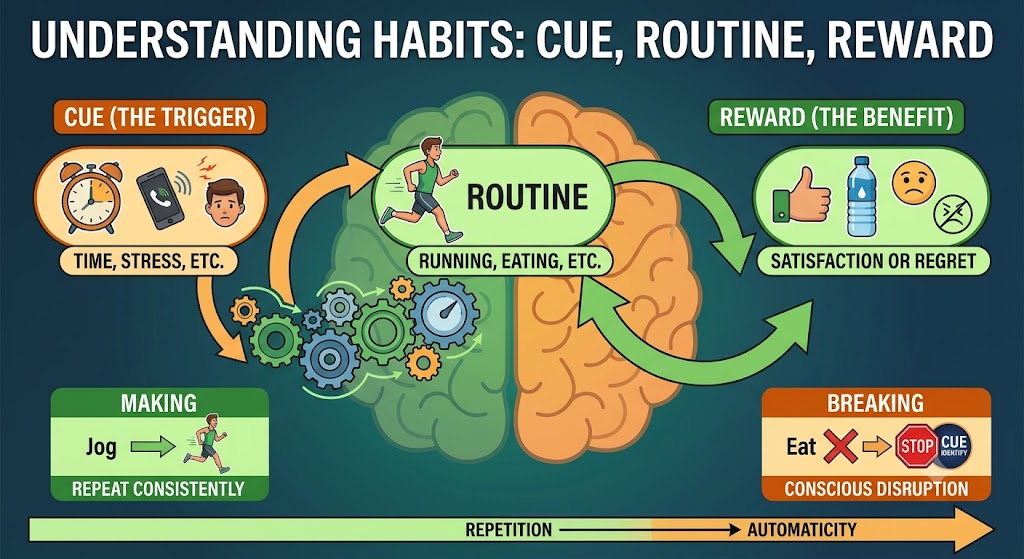
1. How Habits Actually Work
Every habit, good or bad, follows the same simple loop. Understanding this loop is the key to changing any behaviour. It has three parts that repeat again and again until the action becomes automatic.
First, a trigger that starts the behaviour. Then the routine, the action itself. Finally, the reward, the payoff that tells your brain the loop is worth repeating. Do this enough, and it becomes a habit.
“Every habit is a loop: a cue, a routine, and a reward, repeated until automatic.”
The three parts of a habit:
- The cue or trigger — the trigger that starts it (a time, place, feeling, or event).
- The routine — the behaviour you actually do.
- The reward — the payoff that makes your brain want to repeat it.
2. Why Habits Are So Powerful
Habits exist because your brain loves efficiency. Once a behaviour becomes a habit, your brain can do it on autopilot, saving energy for other things. This is helpful for good habits and dangerous for bad ones.
This is why habits are stronger than motivation. Motivation is a feeling that comes and goes, but a habit runs automatically, whether you feel like it or not. Build the right habits, and good behaviour needs no willpower.
“Motivation gets you started. Habit keeps you going when motivation is gone.”
Why habits beat willpower:
- They run automatically — no daily decision needed.
- They save energy — your brain does not have to think.
- They outlast motivation — working even when you do not feel like it.
3. How to Build a Good Habit
To build a new habit, you use the loop to your advantage. The trick is to make the habit obvious, easy, and rewarding, so your brain naturally wants to repeat it. Small and simple beats big and ambitious.
Start tiny, so small it feels almost too easy, and attach the new habit to something you already do. Reward yourself, and let consistency, not intensity, build the habit over time.
“Make it small, make it easy, and let repetition do the rest.”
How to build a habit:
- Start tiny — begin so small it is impossible to fail.
- Stack it — attach it to an existing habit (“after I brush, I will do this…”).
- Make it easy — remove friction so it is simple to do.
- Reward yourself — give your brain a reason to repeat it.
4. How to Break a Bad Habit
Breaking a habit uses the same loop, but in reverse. You cannot easily erase a habit, but you can disrupt its loop, making the bad behaviour harder and less rewarding until it fades.
The most effective move is to attack the cue and the ease of the routine. Remove or avoid the triggers, add friction so the bad habit is harder to do, and take away its reward.
“You do not erase a bad habit. You make it too hard and too dull to bother with.”
How to break a habit:
- Remove the cue — avoid the triggers that set it off.
- Add friction — make the bad habit harder to do.
- Replace it — swap the routine for a better one with a similar reward.
- Remove the reward — take away what makes it satisfying.
5. Make the Environment Do the Work
One of the most powerful and overlooked truths about habits is that your environment shapes your behaviour more than your willpower does. Change your surroundings, and you change your habits almost effortlessly.
Design your space so good habits are easy and bad ones are hard. Keep healthy food visible and junk out of sight. Put your phone in another room to read. Let your environment nudge you the right way.
“Do not fight your environment with willpower. Redesign it to work for you.”
How to shape your environment:
- Make good habits obvious — keep cues for them in plain sight.
- Make bad habits invisible — remove their triggers from view.
- Reduce friction — for good habits; add it for bad ones.
6. Be Patient and Consistent
Habits do not form overnight. They take time and repetition to become automatic, and how long varies from person to person and habit to habit. The key is to keep going, even imperfectly.
Do not aim for perfection; aim for consistency. Missing once is fine; missing twice starts a new pattern. Focus on showing up again and again, and let the habit slowly take root.
“Consistency, not perfection, is what turns an action into a habit.”
How to stay the course:
- Expect it to take time — habits form through repetition.
- Never miss twice — one slip is fine; two starts a new habit.
- Focus on showing up — consistency matters more than intensity.
The Takeaway
Habits are not about willpower or character. They are a simple, predictable system, a loop of cue, routine, and reward, that you can learn to control. Master this, and you can reshape your behaviour and your life.
Here is the whole idea in one glance:
- The habit loop — cue, routine, reward
- Habits beat willpower — they run on autopilot
- Build good ones — make them small, easy, and rewarding
- Break bad ones — disrupt the cue and remove the reward
- Shape your environment — let it do the work
- Stay consistent — repetition, not perfection
“Small habits, repeated daily, are the quiet architects of the life you end up with.”
Pick one small habit to build or break this week, and use the loop, tweak the cue, the routine, or the reward. Real change is built one small habit at a time.
Which habit will you work on first? Share it in the comments, and pass this on to someone trying to change for the better.
Leave a Reply