Most people think the secret to wealth is a big income or a lucky bet. So they wait for the big break and ignore the slow, boring path.
But the richest investors will tell you something different. The real engine of wealth is not luck or timing. It is a silent force that works while you sleep, year after year.
That force is compound interest. Albert Einstein is often said to have called it the eighth wonder of the world, and once you see how it works, you will understand why.
“Compound interest is the quiet snowball. Small at first, unstoppable later.”
You do not need to be a finance expert to use it. You just need to understand it, start early, and stay patient. Let us see how it actually grows your money.
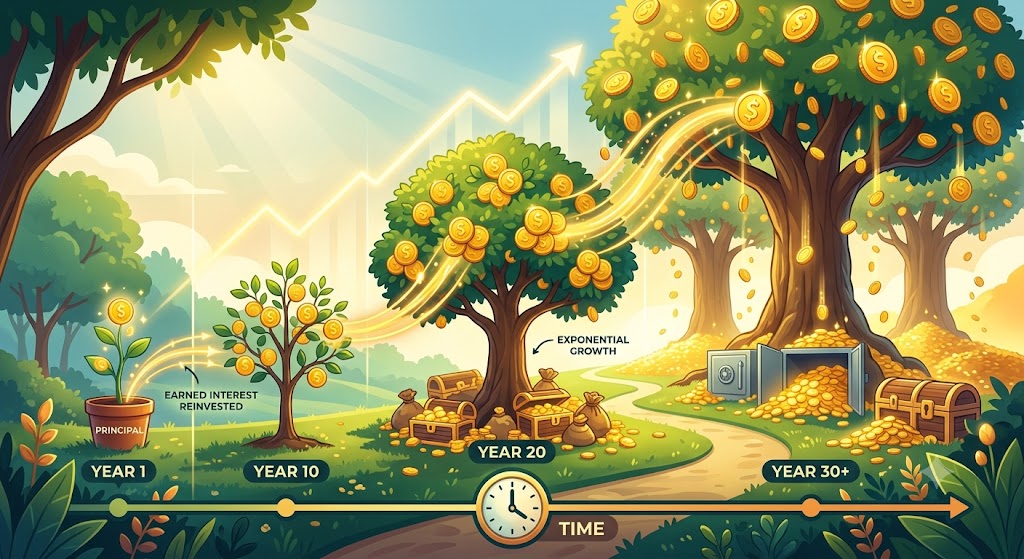
What Compound Interest Really Is
Simple interest earns you money only on the amount you put in. Compound interest is smarter: it earns money on your original amount and on all the interest you have already earned.
In plain words, your returns start earning their own returns. Each year your money grows on a bigger base than the year before, so the growth speeds up over time.
“Compounding is interest earning interest. Your money starts working for you, then its earnings join in too.”
Why it beats simple interest:
- Simple interest — you earn only on the original amount, year after year.
- Compound interest — you earn on the original amount plus all past gains.
- The gap grows — over short periods the difference is small, over decades it is huge.
Time Is the Real Magic
The biggest secret of compounding is not the interest rate. It is time. The longer your money stays invested, the more dramatic the growth becomes.
For the first few years it feels slow and almost not worth it. Then, quietly, it picks up speed. The later years grow far more money than the early ones, because the base is so much bigger.
“Compounding is boring for years, then suddenly it is amazing. Most people quit before the good part.”
Why time matters so much:
- Early years are slow — the snowball is small, so the growth looks tiny.
- Later years explode — the same rate on a much bigger base creates large gains.
- Quitting early kills it — you miss the most powerful, fastest-growing years.
A Simple Example
Numbers make this real. Say you invest ₹5,000 every month and earn around 12% a year, a reasonable long-term return from equity mutual funds. Watch what time does to it.
The amount you put in barely changes per year, but the total grows faster and faster. Most of the final wealth is not your invested money at all, it is the growth on your invested money.
“In the long run, most of your wealth is not what you saved. It is what your savings earned.”
Roughly how ₹5,000 a month can grow at about 12%:
- In 10 years — you put in ₹6 lakh, and it grows to around ₹11–12 lakh.
- In 20 years — you put in ₹12 lakh, and it grows to around ₹45–50 lakh.
- In 30 years — you put in ₹18 lakh, and it grows to around ₹1.5 crore or more.
These are approximate figures for illustration. Real returns vary with the market, and nothing is guaranteed.
The Cost of Waiting
Every year you delay to invest, you do not just lose one year, you lose your most powerful future year. The cost of waiting is expensive.
A person who starts at 25 will often end up with far more than someone who starts at 35, even if the late starter invests more money each month. Time does the heavy lifting that extra money cannot match.
“The best time to start was years ago. The second best time is today.”
What delay really costs you:
- Lost years compound too — a missed early year would have been your biggest later.
- Catching up is hard — starting late often means investing far more to reach the same goal.
- Starting beats waiting — a small amount now beats a perfect plan you never begin.
How to Put Compounding to Work
Understanding compounding is useless unless you act on it. The good news is that the steps are simple, and anyone can follow them.
You do not need a big amount or perfect market timing. You need to start, stay regular, and leave your money alone to grow.
“Compounding rewards the patient and punishes the restless. Start, stay, and wait.”
How to make it work for you:
- Start now — begin with whatever you can, even a small monthly amount.
- Stay regular — invest a fixed sum every month through ups and downs, like an SIP.
- Reinvest your gains — let returns stay invested so they compound, instead of pulling them out.
- Be patient — give it years, not months; the big growth comes late.
The Takeaway
Compound interest is not flashy, and that is exactly why most people ignore it. But it is the most reliable way to turn ordinary savings into real wealth, with no luck required.
Here is the whole idea in one glance:
- It is interest on interest — your returns earn their own returns
- Time is the magic — the longer you stay, the faster it grows
- Most wealth is growth — over decades, earnings outweigh what you put in
- Waiting is costly — starting late means missing your most powerful years
- Start, stay, reinvest, wait — the four simple rules of compounding
“You do not need to be rich to start compounding. You need to start, and let time make you rich.”
Start a small, regular investment this month and let it sit. The most powerful financial decision is often the most boring one: begin, and do not stop.
When did you start compounding, or are you starting today? Share below, and pass this on to someone who needs to begin.
Leave a Reply