Ask most people to name a good investment, and they will picture something exciting: a hot stock tip, a promising startup, a fund manager who always beats the market. The idea of investing feels like it should require skill, research, and inside knowledge.
But here is the truth that most financial experts agree on: for the vast majority of investors, especially beginners, one of the best investments available is also one of the simplest and most boring: an index fund.
No stock-picking. No complex analysis. No expensive manager. Just a low-cost fund that tracks the whole market and, over time, grows with it. Here is why index funds work so well and how to get started.
“The most powerful investment strategy is often the most boring one.”
Let us look at what index funds are and why they suit beginners so well.
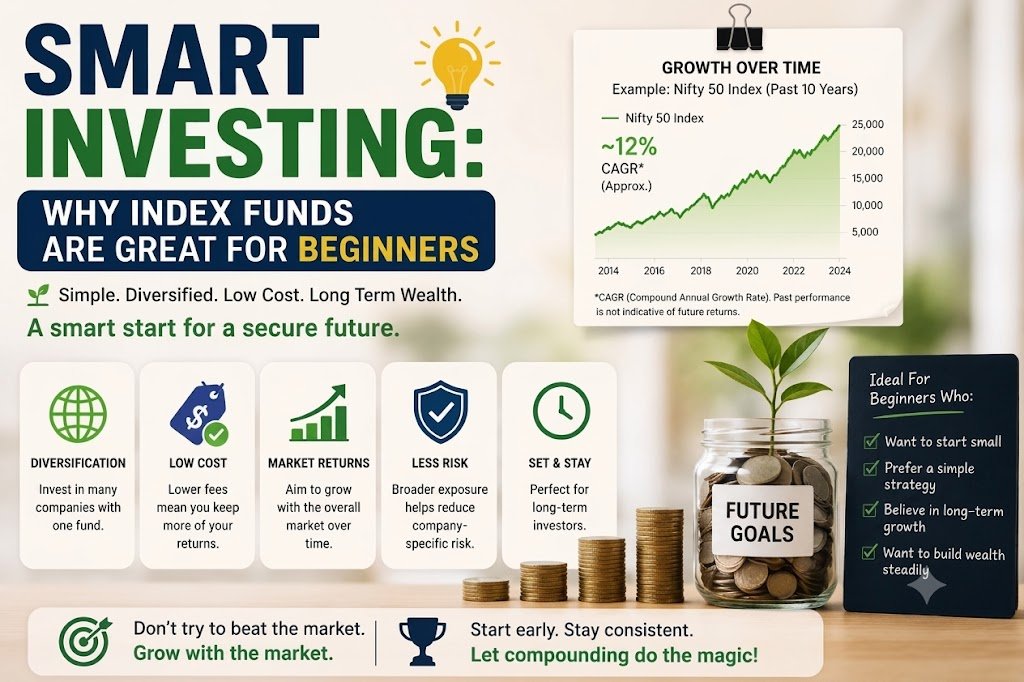
1. What an Index Fund Actually Is
An index fund is a type of mutual fund or ETF that simply tracks a market index, like the Nifty 50 or the BSE Sensex. Instead of a fund manager picking stocks, the fund automatically holds all the stocks in that index, in the same proportions.
If the Nifty 50 goes up, your index fund goes up. If it falls, your fund falls. It mirrors the market, nothing more, nothing less. There is no attempt to beat the market, just to match it.
“An index fund does not try to beat the market. It simply becomes the market.”
How it works:
- Tracks an index — holds every stock in a market index.
- No stock picking — no manager choosing winners and losers.
- Mirrors performance — rises and falls with the overall market.
2. Why Low Cost Matters So Much
One of the most important and least glamorous advantages of index funds is their cost. Because no one is actively picking stocks, the fees are very low, a fraction of what actively managed funds charge.
This sounds small, but fees compound just like returns do. Over decades, even a 1% difference in annual fees can eat a huge chunk of your final wealth. Lower costs mean more of the market’s returns stay in your pocket.
“In investing, what you do not pay in fees is as important as what you earn in returns.”
Why low fees matter:
- More of your money grows — less lost to management charges.
- Fees compound too — a small annual charge shrinks into a large loss over decades.
- Index funds win here — typically far cheaper than active funds.
3. Why Most Active Funds Underperform
The case for index funds is not just about cost. Study after study has shown that most actively managed funds, run by professional stock-pickers, fail to beat the index over the long term. Most underperform after fees.
This is not because fund managers are bad at their jobs. Markets are extremely efficient, and consistently picking better stocks than millions of other smart investors is genuinely very hard. Most cannot do it reliably, year after year.
“Beating the market is hard for professionals. Matching it is easy for everyone.”
Why active funds struggle:
- Markets are efficient — good information is quickly priced in.
- Fees drag returns — active funds must significantly beat the index just to match it after charges.
- Consistency is rare — past outperformers often revert to average.
4. Simple, Transparent, and Easy to Understand
For a beginner, one of the most underrated benefits of index funds is their simplicity. You always know exactly what you own, every company in the index, and how the fund is doing, simply by checking the index level.
There is no need to research individual companies, follow fund manager decisions, or analyse complex strategies. The simplicity makes it easy to start, easy to maintain, and easy to stay invested through market ups and downs.
“You never have to wonder what an index fund is doing. Just check the index.”
Why simplicity helps beginners:
- Fully transparent — you know every holding.
- No ongoing decisions — no need to switch funds or pick stocks.
- Easy to understand — straightforward enough for anyone.
5. Built-In Diversification
When you buy an index fund tracking the Nifty 50, you instantly own a slice of 50 of India’s largest companies across multiple sectors. One investment, dozens of companies, automatic diversification.
This matters enormously for beginners who may not have the knowledge or capital to diversify on their own. A single index fund gives you broad exposure right from the start.
“One index fund does in one step what takes many individual investments to achieve.”
What you get automatically:
- Broad exposure — many companies in one fund.
- Sector spread — across banking, IT, pharma, energy, and more.
- Instant diversification — no picking and choosing required.
6. How to Start With Index Funds in India
Getting started is easier than most beginners expect. Several low-cost index funds tracking the Nifty 50, Nifty Next 50, or broader indices are available in India through mutual fund platforms and apps.
A monthly SIP, starting with whatever you are comfortable with, is the ideal way to begin. You invest regularly, benefit from rupee cost averaging, and let the market do its work over the years.
“Starting is the hardest part. After that, an index fund does the rest.”
How to begin:
- Pick a broad index — Nifty 50 or Sensex funds are solid starting points.
- Choose a low-cost fund — compare expense ratios before choosing.
- Start a SIP — invest a fixed amount monthly, automatically.
The Takeaway
Index funds are not exciting, and that is exactly the point. They are low-cost, transparent, diversified, and reliably track the long-term growth of the economy. For a beginner, that combination is hard to beat.
Here is the whole idea in one glance:
- What they are — funds that track a market index automatically
- Low cost — fees are a fraction of active funds
- Active funds mostly underperform — the index beats most managers over time
- Simple and transparent — easy to understand and hold
- Instant diversification — many companies in one fund
- Easy to start — SIP into a Nifty 50 fund and begin
“A boring index fund, held patiently for decades, quietly beats most exciting strategies.”
Open a mutual fund account this week and set up a small SIP in a Nifty 50 index fund. You do not need to be an expert to start; just be consistent.
Have you invested in index funds? Share your experience in the comments, and pass this on to a beginner looking for a simple way to start.
Leave a Reply