You cannot scroll through financial news or social media without bumping into cryptocurrency. Bitcoin, Ethereum, altcoins, NFTs — the noise is constant, and with it comes a steady stream of people claiming overnight riches alongside others warning of ruin.
If you are curious but cautious, you are in the right mindset. Crypto is a genuinely new and complex financial technology, and both the excitement and the warnings have some truth to them. The worst approach is to jump in blindly, and the second worst is to stay completely ignorant.
This guide is not here to convince you to buy or avoid crypto. It is here to give you an honest, clear picture of what it is, how it works, and what the real risks look like, so you can make an informed decision for yourself.
“Curiosity about crypto is healthy. Clarity is what makes it safe.”
Let us walk through the basics every cautious investor should know.
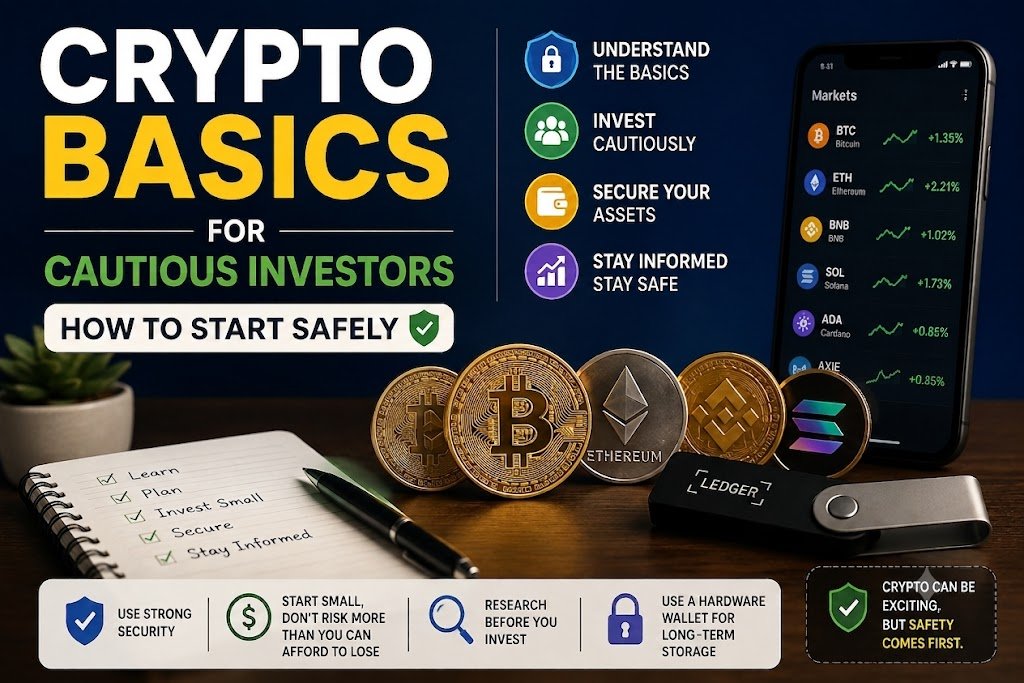
What Cryptocurrency Actually Is
At its core, a cryptocurrency is a digital form of money that runs on a technology called blockchain. Unlike regular money, it is not issued or controlled by any government or central bank. It exists entirely on a decentralised network of computers.
Bitcoin, created in 2009, was the first and remains the most well-known. Since then, thousands of other cryptocurrencies have emerged, each with different features, uses, and risk profiles.
“Crypto is not magic internet money. It is a digital asset on a decentralised network.”
The basics of what it is:
- Digital and decentralised — no government or bank controls it.
- Blockchain-based — transactions are recorded on a shared, public ledger.
- Many varieties — Bitcoin, Ethereum, and thousands of others exist.
Why People Are Interested
The appeal of crypto comes from a few directions. Some see it as a future form of money that bypasses traditional systems. Others see it as a store of value like digital gold. Many, honestly, are attracted by stories of enormous returns.
The underlying blockchain technology also has real applications, from contracts to supply chains, which adds some substance behind the hype. But the investment case and the technology case are very different things.
“There is real technology behind crypto. Whether that makes it a good investment is a separate question.”
What draws people to it:
- Potential returns — some early investors made large gains.
- Decentralisation — freedom from traditional financial systems.
- Technology — blockchain has real-world applications beyond currency.
The Real Risks You Must Understand
Here is where caution pays off. Cryptocurrency is one of the most volatile, unpredictable, and risky asset classes in existence. Prices can rise dramatically and fall just as dramatically, sometimes within days.
Unlike stocks, which represent real companies with earnings, or property, which has tangible value, most cryptocurrencies have no underlying cash flow or intrinsic value. Their price depends entirely on what buyers are willing to pay, which can change without warning.
“Crypto can make you rich quickly and lose you everything just as fast.”
Key risks to know:
- Extreme volatility — prices swing wildly and unpredictably.
- Regulatory risk — governments worldwide are still deciding how to treat it.
- No safety net — no deposit insurance, no central authority to protect you.
- Scams and fraud — the space attracts a disproportionate number of bad actors.
What the Indian Regulatory Picture Looks Like
In India, cryptocurrency sits in a complex and evolving regulatory space. It is not banned, but it is not treated as legal tender either. The government currently taxes crypto gains at a flat rate, and the rules continue to develop.
Before investing, understanding the current tax treatment and regulatory status is essential, not just the potential gains. Rules in this space can change significantly and quickly.
“In India, crypto is taxed and regulated. Know the rules before you trade.”
What to know about India and crypto:
- Not illegal — but not legal tender either.
- Heavily taxed — gains are taxed at a flat rate currently.
- Evolving rules — regulations continue to change; stay updated.
If You Still Want to Explore It
If, after understanding the risks, you still want a small exposure to crypto, a cautious, disciplined approach is far better than diving in driven by fear of missing out.
A few principles help protect cautious investors from the worst outcomes in this space.
“If you enter crypto cautiously, stay cautious. The hype will always push the other way.”
A cautious approach:
- Only invest what you can afford to lose entirely — treat it as a high-risk speculation, not a savings vehicle.
- Keep it a small slice — a tiny portion of your overall portfolio, not the core.
- Use reputable platforms — regulated exchanges with strong security.
- Avoid tips and hype — decisions driven by hype and tips almost always end badly.
The Takeaway
Cryptocurrency is real, genuinely novel, and carries both legitimate interest and serious risk. A cautious investor is right to be curious and right to be careful. Understanding what it is, what drives it, and what can go wrong is the foundation of any sensible decision.
Here is the whole idea in one glance:
- What it is — digital, decentralised money on blockchain
- Why it interests people — returns, technology, and freedom from banks
- The real risks — extreme volatility, no safety net, scams
- Indian context — taxed and regulated, rules still evolving
- If you explore it — only risk what you can fully afford to lose
“The wisest crypto investors are not the boldest. They are the most informed and the most disciplined.”
If crypto interests you, spend more time learning than deciding. The best investment you can make before any crypto purchase is in your own understanding.
Are you curious about crypto, invested, or steering clear? Share your thoughts in the comments, and pass this on to someone trying to make sense of it all.
Leave a Reply