Ask an older relative where to put your money, and the answer is almost always the same: buy land or a flat. Property is real, you can see it, and it never lets you down.
Ask a younger investor, and you will hear the opposite. Forget property, they say, the stock market gives better returns and avoid headaches of tenants and repairs.
Both sides believe they are right. The truth is that real estate and stocks are very different assets, each with real strengths and real weaknesses. The best choice depends on your money, your goals, and your patience.
“The question is not which is better. It is which is better for you, right now.”
Let us compare them honestly, without the hype from either side.
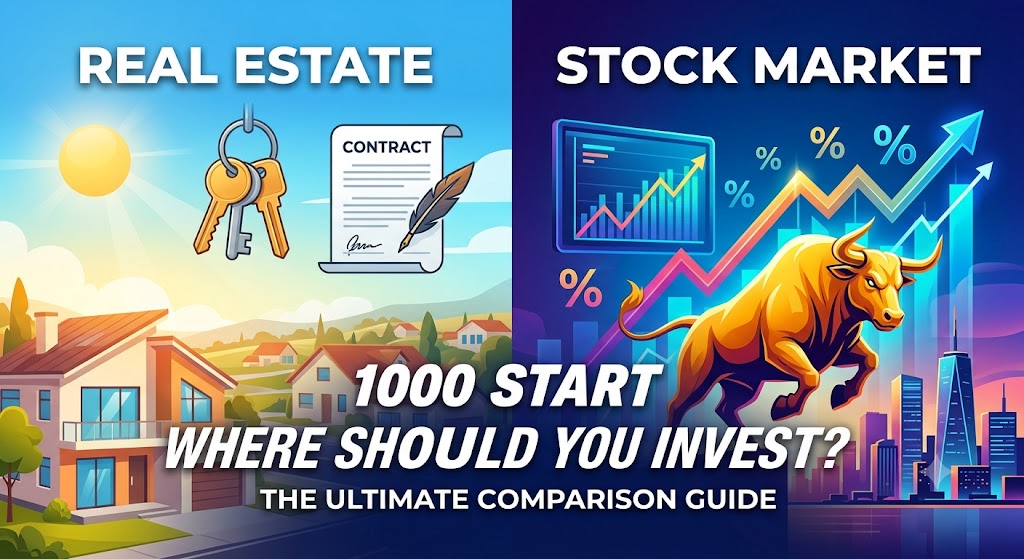
The Case for Real Estate
Real estate holds an emotional and practical pull that stocks cannot match. You can live in it, rent it out, or simply look at it and feel secure. It is wealth you can touch.
Property can also grow in value over time and earn rent along the way. For many families, a home is both a roof and a long-term asset.
“A house is the rare investment you can also live inside.”
What makes real estate attractive:
- Tangible asset — a physical thing you can use, rent, or pass on.
- Rental income — a property can pay you a steady monthly return.
- Forced saving — an EMI quietly builds an asset you might not have saved for otherwise.
The Downsides of Real Estate
Property looks safe, but it hides real problems. The biggest is the huge amount of money locked into a single asset that you cannot sell quickly.
It also comes with ongoing costs and effort. Maintenance, taxes, tenant troubles, and paperwork all eat into the returns that look so good on paper.
“Real estate ties up a fortune in one spot and asks you to wait years to free it.”
Where real estate falls short:
- Low liquidity — selling takes months, and you cannot sell just a part of it.
- High entry cost — you need a large sum or a big loan even to begin.
- Hidden costs — maintenance, taxes, registration, and repairs reduce real returns.
The Case for the Stock Market
Stocks and equity mutual funds let your money grow without the weight of owning physical property. You can start with a small amount and add to it whenever you like.
Over the long term, well-chosen equity has historically delivered strong returns and beaten inflation. And you can sell some or all of it in a day if you need the cash.
“The stock market lets you own great businesses without managing a single brick.”
What makes stocks attractive:
- Start small — invest a few hundred rupees through an SIP, no loan needed.
- High liquidity — buy or sell quickly, and withdraw exactly what you need.
- Strong long-term growth — equity has historically beaten most other asset classes over decades.
The Downsides of the Stock Market
The freedom of stocks comes with a price: volatility. Prices swing up and down, sometimes sharply, and seeing your money drop sharply can be hard to digest.
The market also tests your discipline. Many people buy in excitement and sell in fear, locking in losses. The risk is rarely the market itself, it is human behaviour.
“Stocks do not punish risk. They punish panic.”
Where the stock market falls short:
- Volatility — values can fall fast in the short term, which feels stressful.
- No guarantee — returns are not fixed and depend on the market.
- Needs discipline — staying calm and invested through crashes is harder than it sounds.
Real Estate vs Stocks: Quick Comparison
Here is how the two stack up across the things that matter most. Use it as a snapshot to guide your thinking, not a final verdict.
“Compare them by what your money needs to do, not by which feels safer.”
| Feature | Real Estate | Stock Market |
|---|---|---|
| Entry cost | Very high | Very low, start small |
| Liquidity | Low, sells slowly | High, sells in a day |
| Effort | High, ongoing | Low, mostly passive |
| Income | Rent | Dividends, growth |
| Risk type | Less visible, locked in | Visible, daily swings |
| Diversification | Hard, one big asset | Easy, spread widely |
So Where Should You Invest?
For most people, the smartest answer is not choosing one, but using both over time. Each has a place in a healthy financial life.
A home you live in can give stability and forced saving. Stocks and mutual funds can give growth and flexibility. The mix depends on your stage and your money.
“Own a home for stability, own equity for growth. You do not have to pick just one forever.”
A sensible way to think about it:
- For a home to live in — real estate gives stability and ends rent over the long run.
- For pure growth — equity usually beats property after costs, with far less hassle.
- Build the base first — clear costly debt and build an emergency fund before either.
The Takeaway
Real estate and the stock market are not enemies. One offers solidity and a place to live, the other offers growth and freedom. The mistake is treating either as the only true path.
Here is the whole idea in one glance:
- Real estate — tangible, earns rent, but costly, illiquid, and high-effort
- Stock market — low entry, liquid, strong long-term growth, but volatile
- A home to live in — fits real estate well
- Pure growth — usually favours equity after costs
- Use both — match each to your stage and goals
“Wealth is rarely built on one bet. It is built by using the right tool for the right job.”
Look at your goals this week and decide where to park your money. Stability, growth, or a roof over your head will point you to the answer.
Real estate, stocks, or a mix of both? Share your view in the comments, and pass this on to someone weighing the same choice.
Leave a Reply