It happens in almost every home. Your child is stuck on a sum or a sentence, frustration is rising, and bedtime is near. The fastest way out is obvious: just give them the answer and move on.
It feels like helping. But, doing the work for them teaches the opposite of what you want. It tells them the goal is a finished sheet, not real understanding, and that they cannot do hard things on their own.
The real skill of homework help is harder and far more valuable: being there to support without taking over. You want to build a child who can think, struggle, and solve, not one who waits for you to rescue them.
“Your job is not to give the answer. It is to help them find it.”
Here is how to help with homework in a way that actually helps.
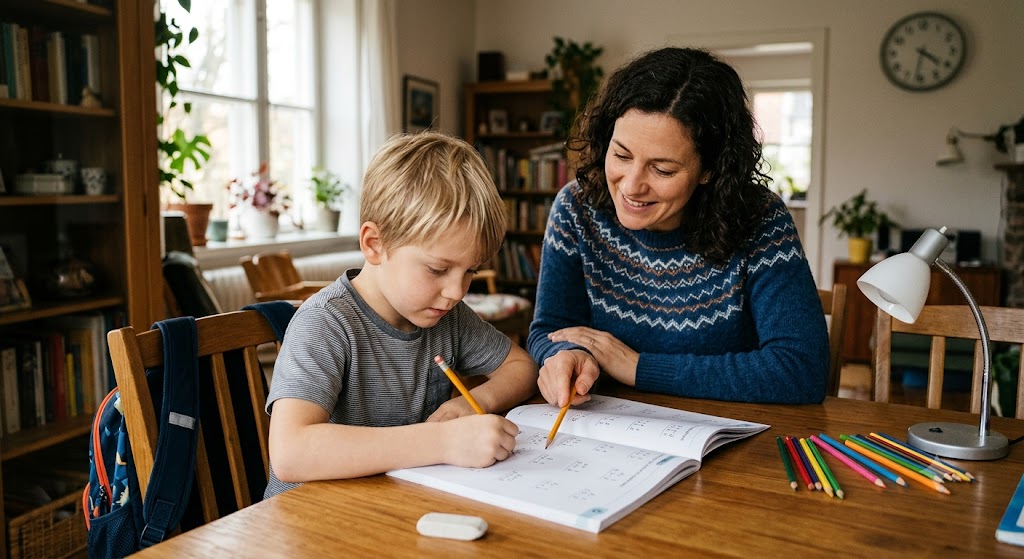
1. Be the Guide, Not the Answer Paper
The first shift is in your role. You are not there to complete the homework. You are there to coach, encourage, and steer when they are truly stuck. The work stays theirs.
When your child hits a wall, resist the urge to jump in with the answer. Instead, ask a question that nudges them toward it. Make them do the thinking while you hold the torch.
“A good helper lights the path. They do not carry the child down it.”
How to coach instead of do:
- Ask, do not tell — “what do you think comes next?” beats giving the answer.
- Hint, do not solve — point them toward the next step, let them take it.
- Let them write — the pen stays in their hand, always.
2. Let Them Struggle a Little
Struggle is not the enemy of learning. It is learning. When a child fight with a problem and finally cracks it, the lesson sticks far deeper than any answer you could hand them.
So when they get stuck, pause before stepping in. Give them time to think, try, and fail a little. That uncomfortable middle is exactly where real understanding is built.
“The struggle is not a problem to remove. It is the lesson itself.”
Why a little struggle helps:
- It builds resilience — kids learn that hard does not mean impossible.
- It deepens learning — answers they work for are answers they remember.
- It grows confidence — solving it themselves proves they can.
3. Teach Them How to Find Answers
A child who learns how to find answers gains a skill that lasts a lifetime. Far more useful than any single sum is the ability to figure things out independently.
Instead of supplying facts, show them where and how to look. Point them to their textbook, notes, or a dictionary. Teaching them to research beats teaching them to ask you.
“Give a child an answer and homework is done. Teach them to find answers and learning is done.”
How to build this skill:
- Point to resources — textbooks, notes, and dictionaries first.
- Show the method — how to reread the question or check an example.
- Encourage rechecking — teach them to verify their own work.
4. Create the Right Environment
Sometimes the best help is not about the homework at all. It is about setting up conditions where focus comes easily. A calm, organised space does half the work for you.
Give your child a silent, well-lit spot, free of screens and noise, with the supplies they need. When the setting supports focus, homework battles shrink on their own.
“A good study space prevents more homework battles than any lecture.”
How to set the stage:
- A fixed spot — a quiet, well-lit place kept for study.
- Remove distractions — no TV, phones, or noise during homework.
- Keep supplies ready — pens, paper, and tools within reach.
5. Praise Effort, Not Just Results
What you praise shapes what your child values. If you only celebrate correct answers and top marks, they learn to fear mistakes. If you praise effort, they learn to keep trying.
Notice and appreciate the hard work, the focus, and the persistence, regardless of whether every answer was right. This builds a child who values trying over being perfect.
“Praise the effort, and you raise a child who keeps trying.”
How to praise well:
- Notice the effort — “you worked hard on that” over “you are so smart.”
- Welcome mistakes — treat errors as a normal part of learning.
- Celebrate persistence — reward sticking with a hard problem.
6. Know When to Step Back
A big part of helping is knowing when to stop. Hovering over every problem teaches dependence. Over time, your goal is to be needed less and less, until they can do it all alone.
As your child grows more capable, slowly pull back. Be available, but not glued to their side. Let them own their homework, their mistakes, and their successes.
“The aim of homework help is to make yourself unnecessary.”
How to step back gradually:
- Reduce hovering — be nearby, not on top of every problem.
- Let them own it — including the consequences of incomplete work.
- Build independence — aim for them to need you a little less each year.
The Takeaway
Helping with homework the right way is not about being more involved. It is about being involved more wisely, supporting your child’s thinking instead of replacing it, so they grow into a confident, independent learner.
Here is the whole plan in one glance:
- Be the guide — coach and hint, never do it for them
- Allow struggle — the hard part is where learning happens
- Teach them to find answers — a skill that lasts a lifetime
- Set up the space — a calm, distraction-free spot
- Praise effort — value trying over perfect results
- Step back slowly — aim to be needed less each year
“The best homework help raises a child who, one day, no longer needs your help at all.”
Try one shift this week, maybe answering a “stuck” moment with a question instead of the answer. Small changes in how you help build a stronger, more confident learner.
How do you handle homework time at home? Share your approach in the comments, and pass this on to a parent in the homework trenches.
Leave a Reply