Two people face the same failure. One thinks that it can’t be done and gives up. The other studies what went wrong, learns from it, and comes back stronger. Same event, opposite results.
The difference is not talent, luck, or intelligence. It is something far more powerful: the way each person thinks about their own ability to grow. This is the heart of mindset.
Famous psychologist Carol Dweck told people tend to hold one of two beliefs about their abilities, and that single belief shapes almost everything, including how they handle challenges, failure, effort, and success. Let us break down the difference.
“Your mindset is the lens through which you see every setback and every chance.”
Here is what separates a growth mindset from a fixed one, and why it matters so much.
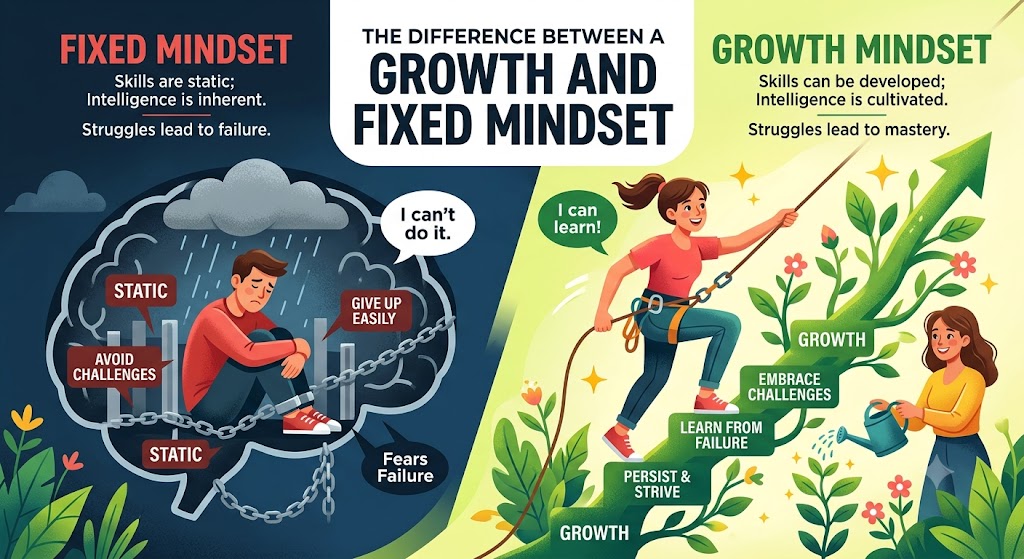
What a Fixed Mindset Looks Like
A fixed mindset is the belief that your abilities are set in stone. You are either smart or you are not, talented or you are not, and nothing can really change that. You are born with a certain amount, and that is it.
This belief sounds harmless, but it holds people back. If you think ability cannot grow, then failure feels like proof of your limits, and effort feels pointless. So you avoid both.
“A fixed mindset sees ability as a fixed cup. A growth mindset sees it as a muscle.”
Signs of a fixed mindset:
- Avoids challenges — sticks to the safe and easy to protect the ego.
- Fears failure — sees mistakes as proof of being “not good enough.”
- Gives up easily — quits when things get hard.
What a Growth Mindset Looks Like
A growth mindset is the belief that abilities can be developed through effort, learning, and practice. You are not stuck with what you have; you can get better at almost anything with time and work.
This belief changes everything. If ability can grow, then challenges become chances to improve, failure becomes feedback, and effort becomes the path forward, not a sign of weakness.
“In a growth mindset, you are not failing. You are learning.”
Signs of a growth mindset:
- Embraces challenges — sees hard things as chances to grow.
- Learns from failure — treats mistakes as useful feedback.
- Values effort — knows that trying is how ability is built.
How the Two Handle Failure
The thing is how each mindset treats failure. To a fixed mindset, failure is a verdict, a permanent label. To a growth mindset, failure is just information, a step on the way.
This single difference explains why some people bounce back from setbacks while others are crushed by themself. It is not that one fails less. It is that they read failure completely differently.
“Failure ends the fixed mindset. It teaches the growth mindset.”
The two reactions to failure:
- Fixed — “I failed, so I am a failure. I should stop.”
- Growth — “I failed, so I learned something. Let me try again.”
- The result — one quits, the other improves.
How the Two Handle Effort
Both mindsets actually see effort differently. A fixed mindset views effort with suspicion, if you were truly talented, it should come easily, so working hard means you lack ability.
A growth mindset sees effort as the whole point. Hard work is how skill is built, and struggling at something new is a sign of growth, not a sign of being untalented.
“To the fixed mind, effort is proof of weakness. To the growth mind, it is proof of progress.”
How each sees effort:
- Fixed — “If I have to try hard, I must not be good at this.”
- Growth — “Trying hard is exactly how I get good at this.”
- The impact — one avoids effort, the other seeks it.
Why Your Mindset Shapes Your Life
Over time, these two mindsets lead to very different lives. The fixed mindset, always protecting itself, avoids risks, stops learning, and stays stuck. The growth mindset keeps stretching, learning, and improving.
It compounds. Every challenge faced or avoided, every failure learned from or feared, adds up over the years into two completely different trajectories. Mindset quietly decides how far you go.
“Your mindset does not just shape a moment. Over years, it shapes your whole path.”
Why it matters so much:
- It compounds — small mindset choices add up over a lifetime.
- It shapes action — belief drives whether you try or quit.
- It decides growth — only one mindset keeps you improving.
How to Build a Growth Mindset
The best news of all is that mindset is not fixed either. You can shift from a fixed to a growth mindset with awareness and practice. It starts with catching your own thoughts.
When you notice a fixed thought like “I am just bad at this,” reframe it into a growth one: “I am not good at this yet.” That small word, “yet,” changes everything. Practise it, and the mindset grows.
“Add one word to your self-talk, ‘yet,’ and a fixed mind starts to grow.”
How to grow your mindset:
- Catch fixed thoughts — notice “I can’t” and “I’m not good at this.”
- Add “yet” — turn “I can’t do this” into “I can’t do this yet.”
- Praise effort — value trying and learning over just results.
- Welcome challenges — treat hard things as chances to grow.
The Takeaway
The difference between a growth and a fixed mindset is not about who is smarter or more talented. It is about a single belief, whether you think you can grow, and that belief shapes how you face everything life throws at you.
Here is the whole idea in one glance:
- Fixed mindset — believes ability is set; avoids challenge and effort
- Growth mindset — believes ability grows; embraces challenge and effort
- On failure — one quits, the other learns
- On effort — one hides from it, the other seeks it
- It compounds — mindset shapes your whole path over time
- It can change — awareness and “yet” build a growth mindset
“You are not born with a fixed amount of ability. You grow it, if you believe you can.”
Catch one fixed thought today and add the word “yet” to it. That tiny shift is the first step from a fixed mindset to a growing one.
Which mindset do you catch yourself in most? Share your thoughts in the comments, and pass this on to someone who needs to hear that ability can grow.
Leave a Reply