Think about the last thing that kept you up at night. A difficult person at work. A decision someone else made. Traffic. The weather on an important day. What other people think of you. The economy.
Now ask yourself honestly: did any amount of worrying change it?
Most of the things that stress us most are things we have little or no control over. Yet we grip them tightly, losing sleep, energy, and peace over outcomes that were never ours to decide. This habit of holding on costs us enormously, and we rarely even notice it quietly.
Learning to let go is not giving up. It is one of the most powerful and freeing things you can do for your mind. Here is how to start.
“You will find peace not by controlling everything, but by releasing what you never could.”
Let us look at how to let go of what is not yours to control.
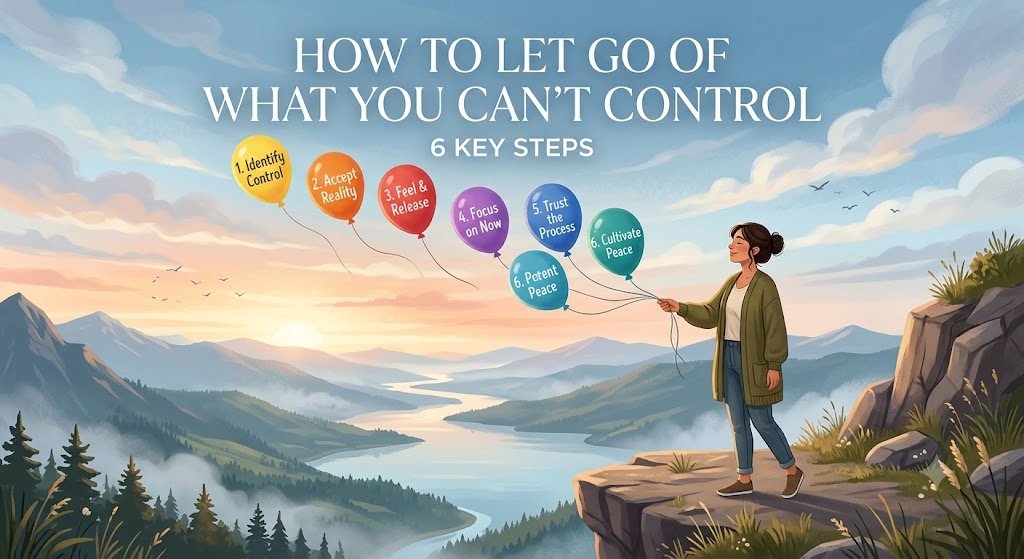
1. Understand What Is and Is Not in Your Control
The ancient Stoic philosophers had a simple but life-changing idea: focus only on what you control, and accept everything else. Two thousand years later, it remains among the wisest pieces of advice anyone has ever given.
In any situation, there are things within your control: your actions, your words, your attitude, and your effort and things outside it: other people’s choices, outcomes, timing, and circumstances. The trouble starts when we treat the second list as if it were the first.
“What you control: your effort, attitude, and response. Everything else is not yours.”
How to draw the line:
- In your control — your actions, words, effort, and reactions.
- Out of your control — other people, outcomes, timing, and the past.
- Your work — focus fully on what you can control, and release the rest.
2. Notice the Cost of Holding On
Before you can let go, it helps to see how much holding on actually costs you. Clinging to what you cannot change does not fix anything; it just drains you. The outcome stays the same, but you arrive at it exhausted and tense.
Anxiety, sleeplessness, resentment, and frustration are often the price of fighting battles that were never yours to win. Seeing this cost clearly is often enough to loosen the grip.
“Holding on to what you cannot control costs you peace without changing the outcome.”
What holding on costs you:
- Sleep and rest — worry keeps the mind running on empty.
- Energy and focus — stress on the uncontrollable leaves less for what matters.
- Peace — constant tension over what you cannot change.
3. Accept Without Approving
A common misunderstanding is that letting go means agreeing with or approving of what happened. It does not. You can accept a situation as real, while still disliking it, and still working to change what you can.
Acceptance simply means stopping the internal fight against reality. It does not mean being passive. It means spending your energy on your response rather than on wishing things were different.
“Acceptance is not approval. It is choosing to deal with reality instead of fighting it.”
What acceptance really means:
- Not approval — you can dislike it and still accept it.
- Not passivity — you can accept and still act on what you control.
- Not forever — accepting where you are now, while still moving forward.
4. Focus Your Energy Where It Counts
Once you stop spending energy on the uncontrollable, you have more of it for the things that actually matter. This shift, from resisting what you cannot change to improving what you can, is where real progress lives.
Ask yourself in any tough moment: what part of this can I actually influence? Then put all your energy there, and release the rest. This single habit changes how you approach almost every challenge.
“Energy spent on the uncontrollable is energy stolen from where you can make a difference.”
How to redirect your energy:
- Ask what you control — find the piece that is yours to act on.
- Work on that — pour all your effort into what you can change.
- Release the rest — let go of the piece that is not yours.
5. Build Practices That Help You Release
Letting go is a skill, and like all skills, it gets easier with practice. Certain simple habits can help you release what you are gripping, gently and repeatedly, until it starts to feel natural.
These are not magic cures, but small, steady tools that help you loosen the tight hold on outcomes and people you cannot control.
“Letting go is a practice, not a single moment. It gets easier every time.”
Practices that help:
- Write it out — putting worries on paper gets them out of your head.
- Breathe through it — slow, deliberate breathing calms the gripping reflex.
- Name the feeling — saying “I am anxious about X” separates you from it.
6. Give Yourself Time and Patience
Some things are genuinely hard to let go of: a betrayal, a loss, a deep disappointment. It is unrealistic and unkind to expect yourself to release these in a moment. Letting go of big things is a process, not a switch.
Be patient with yourself. Each time you choose to return your attention to what you can control, rather than spiralling over what you cannot, you are practising. And every practice makes the next one a little easier.
“Letting go is not done once. It is done again and again, a little easier each time.”
How to be patient with yourself:
- Allow the time — big things take longer to release.
- Be kind — letting go is hard, and that is okay.
- Keep practising — every attempt matters, even the imperfect ones.
The Takeaway
Most of our daily stress is spent on things we never had the power to change. Learning to identify those things, accept them, and redirect your energy toward what you can actually control is one of the most peaceful shifts you can make in life.
Here is the whole idea in one glance:
- Know what you control — actions, effort, and response
- See the cost — holding on drains you without changing the outcome
- Accept without approving — stop fighting reality, start responding to it
- Focus your energy — on what you can actually influence
- Build a practice — write, breathe, and name what you feel
- Be patient — big things take time to release
“When you stop trying to control what you never could, you finally have room to change what you can.”
The next time you feel tense about something, pause and ask: is this in my control? If not, take a breath, and gently put it down. That one small practice is the start of real peace.
What have you learned to let go of? Share your experience in the comments, and pass this on to someone who needs to release the grip.
Leave a Reply