Check your phone right now, and you will probably see a number: hours spent on screens today. For most of us, that number is uncomfortably high, and rising every year without us really deciding it should.
Technology brought incredible gifts: instant information, connection across distances, endless entertainment. But it also silently creates a gap in our daily life: the queue, the meal, the bedtime, until real life started feeling like the background and the screen felt like the main event.
The goal is not to reject technology; that ship has sailed, and the tools are genuinely useful. The goal is balance, using technology on purpose instead of it using you by accident. Here is how to find that balance.
“Technology should fit into your life. Your life should not have to fit around technology.”
Let us look at practical ways to balance the digital world with the real one.
1. Notice How Much You Actually Use
Most people underestimate their screen time badly. The first step to balance is honesty, seeing the real numbers instead of the story you tell yourself about your habits.
Check your phone’s screen time report and look honestly at where the hours go. This awareness alone is often startling enough to spark real change, because you cannot fix what you refuse to see.
“You cannot balance what you refuse to measure.”
How to build awareness:
- Check your screen time — most phones show this automatically.
- Notice the apps — see which ones eat the most hours.
- Be honest — acknowledge the real numbers, no excuses.
2. Create Tech-Free Zones and Times
Boundaries work far better than willpower. Instead of trying to resist your phone constantly, create specific times and places where it simply is not allowed. This removes the daily battle entirely.
Meals, bedrooms, and the first hour after waking are great places to start. When certain zones and times are always screen-free, real life naturally fills that space instead.
“A boundary you set once beats a battle you fight every day.”
Good zones to protect:
- Mealtimes — no phones at the table, for real conversation.
- Bedrooms — keep devices out to protect sleep and intimacy.
- First and last hour — screen-free mornings and bedtimes.
3. Turn Off Unnecessary Notifications
Every buzz and ping pulls your attention away from the real world in front of you. Most notifications are not urgent; they are just apps competing for your focus. Turning them off gives you back control.
Go through your phone and disable notifications for anything that is not truly important. You can still check apps when you choose to, but they stop interrupting your real life uninvited.
“A notification is someone else deciding when you get distracted. Take that decision back.”
How to cut the noise:
- Turn off non-essentials — social media, games, and shopping apps.
- Keep only the vital — calls, messages, and true priorities.
- Check on your terms — open apps when you choose, not when they buzz.
4. Be Fully Present With People
One of technology’s costs is presence. Sitting with someone while glancing at your phone means you are technically there, but not really there. Real connection needs your full attention.
Make a habit of putting your phone away completely during time with family and friends. Being fully present, even for shorter periods, builds far deeper connection than being half-there for longer.
“Half your attention is not really attention at all.”
How to be present:
- Put the phone away — out of sight during time together.
- Make eye contact — engage fully in conversations.
- Choose quality time — short, focused time beats long, distracted time.
5. Rediscover Offline Joys
Part of rebalancing is simply remembering what real-world life feels like. Many offline joys, once so central to life, have faded as screens filled the gaps once used for hobbies, walks, and simple presence.
Reconnect with hobbies, nature, books, or activities that do not involve a screen. These offline joys often provide a deeper, calmer satisfaction than the quick hits of digital entertainment.
“The real world was always there. We just stopped visiting it as often.”
Offline joys to revisit:
- Nature — walks, gardens, or simply sitting outside.
- Hobbies — reading, cooking, art, or anything hands-on.
- Face-to-face time — visiting people instead of only messaging them.
6. Use Technology With Intention
The goal is not to demonise technology, since it genuinely helps us in countless ways. The goal is to use it with intention, choosing when and how, rather than mindlessly scrolling out of habit or boredom.
Before opening an app, ask why. Are you seeking something specific, or just filling empty time by reflex? A moment of intention turns technology from a distraction into a helpful tool.
“Technology is a good servant and a bad master. Choose which one it is for you.”
How to use it intentionally:
- Ask why — before opening an app, know your purpose.
- Set time limits — for apps that easily consume hours.
- Use it for good — learning, connecting, and creating, not just scrolling.
The Takeaway
Balancing digital and real-world life is not about rejecting technology. It is about putting it back in its proper place, a helpful tool you control, rather than a constant pull that quietly replaces real life.
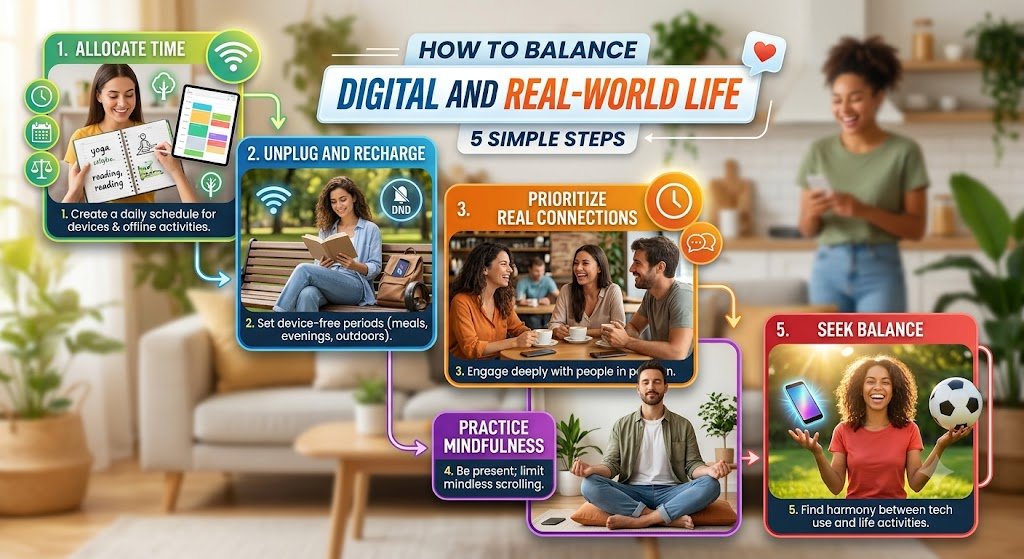
Here is the whole plan in one glance:
- See your real usage — honest awareness of screen time
- Set tech-free zones — meals, bedrooms, and key hours
- Cut notifications — stop unnecessary interruptions
- Be fully present — give people your whole attention
- Rediscover offline joys — hobbies, nature, and face-to-face time
- Use tech with intention — on purpose, not on autopilot
“The best use of technology still leaves plenty of room for real life.”
Pick one boundary to try today, maybe a phone-free meal or turning off a few notifications. Small, deliberate limits help you enjoy technology without losing your real life to it.
How do you balance your digital and real-world life? Share your approach in the comments, and pass this on to someone glued to their screen.
Leave a Reply