New investors rush over one question: how much can I make? They chase the highest returns, the hottest stocks, the biggest gains. And often, they get wiped out by the risks they never thought about.
Seasoned investors think differently. They know that the real secret to long-term success is not maximizing returns, but managing risk. Protecting your money in bad times matters more than winning big in good times.
Here is the hard truth: a big loss hurts far more than an equal gain earn. Lose 50%, and you need a 100% gain just to break even. That is why smart investors focus first on not losing, then on growing. Here are practical risk management tips to help you do the same.
“The first rule of investing is not to make money. It is to not lose it.”
Let us go through ways to protect your investments from the risks that ruin people.
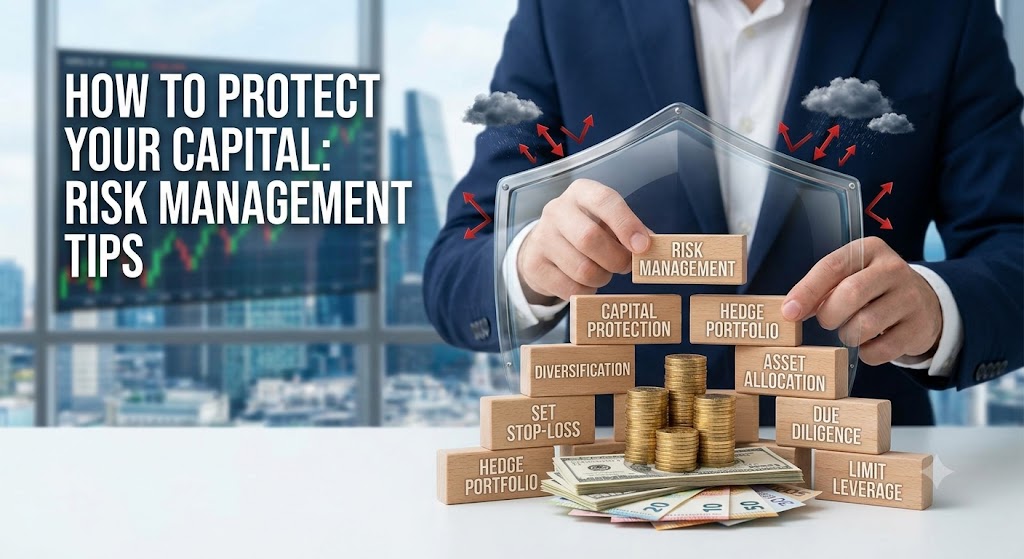
1. Never Invest Money You Cannot Afford to Lose
The most basic risk rule of all: only invest money you will not need soon and can afford to see fall. Investing rent money or emergency savings turns a normal market dip into a personal disaster.
Before you invest a single rupee, secure your foundation. Have an emergency fund and clear your high-interest debt. Then invest only surplus money, so a market fall never forces you to sell at the worst time.
“Money you might need tomorrow has no business in the market today.”
How to invest safely:
- Build an emergency fund — before investing, not after.
- Invest only surplus — money you will not need for years.
- Never borrow to invest — leverage magnifies losses badly.
2. Diversify to Spread Your Risk
Putting all your money in one stock or one sector is the fastest way to get hurt. If that single bet fails, you lose everything. Diversification is your first and best defense.
Spread your money across different stocks, sectors, and asset types. When one falls, others may hold steady or rise. No single failure can then wipe you out. It is simple and it works.
“Diversification will not make you rich fast, but it will keep you from going broke.”
How to diversify:
- Across stocks — many holdings, not one or two.
- Across sectors — do not bet everything on one industry.
- Across assets — mix equity, debt, and gold.
3. Only Risk What Matches Your Comfort
Every investor has a different tolerance for risk, shaped by their age, goals, and temperament. A big mistake is taking on more risk than you can handle emotionally, which leads to panic-selling.
Be honest about how much loss you can digest without losing sleep or making rash moves. Build a portfolio you can hold calmly through a crash, not one that terrifies you when markets fall.
“The best portfolio is not the one with the highest return. It is the one you can actually hold.”
How to match risk to yourself:
- Know your tolerance — how much loss can you bear calmly?
- Consider your timeline — more time means you can take more risk.
- Size positions wisely — never bet so big that a loss is ruinous.
4. Don’t Put Too Much in One Bet
Even within a diversified portfolio, avoid letting any single investment grow too large. A concentrated position, however promising, can badly hurt you if it goes wrong.
A common guideline is to limit how much of your portfolio any one holding can occupy. This way, even your best-conviction idea cannot sink your whole portfolio if it fails.
“Conviction is good. Betting everything on it is not.”
How to limit concentration:
- Cap single holdings — no one stock dominating your portfolio.
- Trim winners — book some profit when one grows too large.
- Stay balanced — keep no single risk oversized.
5. Have an Exit Plan Before You Enter
Many investors decide when to buy but never think about when to sell. Then, when things go wrong, they freeze or panic. Deciding your exit in advance removes emotion from the moment.
Before you invest, know your plan: when you will take profits, and when you will cut losses. Having these rules set in calm times helps you act sensibly when markets get scary.
“Decide how you will leave before you decide how you will enter.”
How to plan your exit:
- Set a loss limit — know how much you will accept losing.
- Plan profit-taking — decide when you will book gains.
- Stick to the rules — follow your plan, not your emotions.
6. Control Your Emotions
The biggest risk to your investments is often not the market, it is you. Fear makes people sell at the bottom; greed makes them buy at the top. Managing emotions is managing risk.
Successful investors stay calm through the noise. They do not panic in crashes or get greedy in booms. They stick to their plan and let discipline, not emotion, drive their decisions.
“The market tests your patience far more than your intelligence.”
How to stay calm:
- Avoid panic selling — do not dump quality assets in fear.
- Resist FOMO — do not chase what everyone is hyping.
- Follow your plan — let rules, not feelings, decide.
7. Keep Reviewing Your Portfolio
Risk is not static. Markets move, your holdings shift, and a portfolio that was balanced last year may be imbalanced today. Regular reviews keep your risk under control.
Check your portfolio periodically, rebalance if one part has grown too big, and adjust as your goals change. This steady maintenance keeps small risks from quietly becoming big ones.
“Risk left unwatched has a habit of growing.”
How to review well:
- Check periodically — review a few times a year, not daily.
- Rebalance — bring your mix back to target.
- Adjust for life — update as your goals and age change.
The Takeaway
Risk management is what separates investors who last from those who blow up. It is not about avoiding risk entirely, that is impossible, but about controlling it so no single event can ruin you.
Here is the whole plan in one glance:
- Invest only spare money — never what you soon need
- Diversify — spread risk so no one bet sinks you
- Match risk to comfort — hold what you can stomach
- Avoid over-concentration — cap any single bet
- Plan your exit — before you enter
- Control emotions — the biggest risk is you
- Review regularly — keep risk in check over time
“Protect your money first, and growth will take care of itself over time.”
Look at your portfolio this week and ask one question: if my biggest holding fell hard tomorrow, would I be ruined? If yes, it is time to manage your risk.
How do you manage risk in your investments? Share your approach in the comments, and pass this on to a fellow investor.
Leave a Reply